
Introduction and Objectives
The aim of this paper is to explore questions
of consciousness and the varying philosophies of relationships of a self to a
body, analyzing the way this self/body interacts with its external environment,
and with other self/bodies. This being thoroughly examined, we are able to
understand how the science of existence supports the philosophies of
existentialism and logotherapy, and how we can create our own meaning and value
through art, creativity, and deliberate choices of consciousness.
Consciousness: Mysticism and Neuroscience
“I not only have a body, I am
a body.”
“I do not have a soul. I am a soul. I have a body.”
What does it mean to “be”? There is a struggle
within humans, a struggle between the romantic world of metaphysics and the
hard, logical world of neuroscience. We struggle to understand just who or what
“we” are– a body, or a brain, or a spirit. There is a certain fetishism toward
the idea of the unconscious; there is a mystique, a way of separating this
unconscious “self” from the fleshy spatio-temporal body that physically
interacts with the outside world. I recently attended a lecture by Doctor Sant
Dharamananda, who holds a doctorate in Eastern Philosophy, in which he
described humanity as “spiritual beings trying to have a human experience”.
This view implies a separation of the mind and the body, and it implies that my
brain doesn’t need “me”. It implies that I own
this body and I own this brain, but
am not limited to these entities. It also assumes that something beyond my
flesh experiences my life, and this body is simply a mediation between “me” and
the outside world.
In an attempt to connect metaphysics with science, these ideas (or ideals) relate to René Descartes’ Cartesian Dualism, the theory that the mind and the brain consist of two different substances. The mind is non-physical, takes up no space and has no position. The body, brain, and physical world, on the other hand, are made of something solid, something that can be measured and described. Descartes argues that the two interact only through the pineal gland, the part of the brain that produces serotonin and affects our wake/sleep cycles, though he provides no explanation as to why this is the only physical part of the body that is able to communicate with the spiritual or mental realm.
 | |
|
Neuroscience, on the other hand, has shed
itself of any romanticism. The majority of neuroscientific research and writing
will agree that we are nothing more than our bodies– in some cases,
consciousness is regarded as simply a pleasant side-effect to existence.
There is a repeated question throughout both philosophy and neuroscience: how do I know where I begin and end? Where does my physical self end and an environment begin? How do I know this hand is mine? In order to be self-conscious, we must be able to identify this boundary– or at least be aware of any abstraction of it. One simple way to approach the question of self-identification is to turn again to science; take, for example, a skin transplant. Should you need to replace lost skin from a wound on your forehead, you may “borrow” and transplant skin from any other part of your body– your thigh, your stomach, anywhere. The only skin that works is yours, or in some cases, the skin of an identical twin, regardless of what part of the body it comes from. While it may be conceptually heavy to consider the borderline between self and non-self, your body knows the answer already. Your DNA and natural chemicals are able to recognize what comes from “you” and what does not.
Our relationships to our bodies are complicated and open to a number of different interpretations and therefore, different approaches. In Freud’s analysis of the psychological self, we are comprised of three different inner “selves”; the id, the ego, and the superego. The id is the unorganized and uncontrollable subconscious, acting according to the pleasure principle and seeking primarily to avoid any pain or displeasure. This relates most closely, perhaps, to the mind that is considered to be separate from our physical forms– the part we can’t quite find or control. The ego, on the other hand, is our conscious perception of our selves. Lastly is the super-ego, or the ego ideal. It is our potentiality, our projected selves, and the consciously or unconsciously desired state of being each individual longs for privately. The ego attempts to mediate between this desired image and the hidden desires of the id.
With this basic groundwork laid out, we can begin to explore the relationship of a person to his or her self. Consider the human as a machine, a faceless skeleton with a set chemical and organic structures. What makes each individual different? There are physical differences that allow us to distinguish our relatives from strangers, as well as differences within individual personalities. Humans naturally strive to be distinguishable as an individual as well as part of a cultural or social group. This is where the social body becomes part of the conversation between the ego and the super ego.
It is almost impossible to escape the social and cultural associations of the body; to analyze the body without looking through a lens of social idealism. Therefore, the body itself becomes damaged by ideological comparative analyses. Through our experiences, we create an individual ideal– sometimes different but inseparable from the pre-established mass or social principles. This is the birth of the super-ego, the “could-be” or potentiality of a being. Especially in contemporary western and internet culture, sub-cultural ideals are apparent. They are defined and strived for by the individual, who wishes to be perceived in a certain way. Therefore, the ego strives to be the super-ego but is unable to escape the id.
It is important to note that it is impossible to lump the psyches of the entirety of the human species into psychological sub-categories. It simply cannot be proven that every individual lives between his id-ego-super-ego, just as it cannot be proven that there is or is not a separation of the mind and the body. Language, labels, and equations are entirely inadequate for describing the way each individual develops a personality and a sense of self. Mind versus body, self versus non-self, and self versus desired self are each important dualities to consider in moving forward and thinking about ways of existence.
The Self in Space, The Body in Space
The sense of one’s own body in space is called proprioception. The dictionary definition of proprioception reads, “the perception of movement and spatial orientation arising from stimuli within the body itself”. This is often considered the “sixth sense”. At times, our proprioception is conscious; we are aware of our body and our surrounding space. Oftentimes, we’re not aware of this unless something is obstructing our usual flow-of-motion, or if we’re particularly focused on our position– such as in a dance. More often than not, however, our sense of proprioception is unconscious, and our relationship to space is passive.
We label our spaces in our lives based on their assigned functionality. “Bedroom”, “marketplace”, “kitchen”, “park”– all of these words carry a connotation and association with them. When we occupy one of these spaces, our brains call back on stored memories, and we know what to do with it based on our knowledge of that space’s pre-determined function and our past experiences in similar spaces. We see a chair and we know we should sit on it– there is no active interaction with/awareness of the object that is the chair itself.
Space is only perceived by a body. We previously discussed the possible role of the fleshy body as a mediator between the “self” and the tangible world. The being becomes oriented in time and space, and codes the actions of that space by choosing how to interact with it. The body in space has a potentiality for play, violence, passivity, and so on.
The body in space also becomes mentally integrated into that space. A room, as well as the objects in it, become a part of our brain’s body maps, which is our brain’s awareness of each individual nerve in our body. Through interacting with a space and with objects, we are relatively extending our bodies.
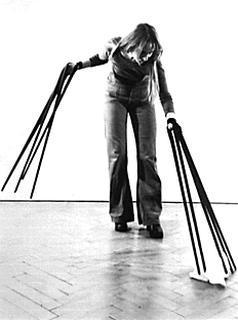 |
| Rebecca Horn, Finger Gloves, 1972 |
There is a Marxian question accompanying the
science of proprioception. Marx wondered whether a spider, when building its
own web, is obeying blind instinct or has (or is) an intelligence. It produces the web from its own bodily
secretions to accommodate its own survival needs. Should we consider this an
abstract space that is separate from the spider and his or her body, or is it
more true to say the spider builds its web as an extension of its body? That
being considered, are human spaces so abstract and separate from ourselves, or
are they, too, extensions of “us”?
Rebecca Horn is a prime example of an artist working with these ideas. Her early work is performative, utilizing sculptures that attach to the body to create extensions of the physical being into space. She is interested in the balance between the figure and objects, between flesh and other substances.
In one of her earlier pieces, Finger Gloves, Horn created finger extensions using cloth and balsa wood. “An instrument to extend the manual sensibility… I can feel, grasp, touch anything with them, but keep a certain distance from the objects… I feel me touching, I see me grasping, I control the distance between me and the objects” (12). This follows the neuroscientific theory that when we wear a tall hat or use a tool such as tongs, our brain’s map of our body extends to include that object. Horn’s work functions almost directly as proof of this phenomenon.
In her other pieces, Horn extends other parts of the body through a variety of tactics. She creates sculptural extensions of arms, legs, the head, and so on. In some experiments, she utilizes feathers as an alternate to human flesh. She describes the sensation of wearing feathered finger extensions; “I touch my bare left hand with my feather-dressed right hand, start to touch it and stroke and carefully examine this new experience. It is as if one hand had suddenly become disconnected from the other, like two utterly unrelated beings. My sense of touch becomes so disrupted that the different behavior of each hand triggers contradictory sensations” (Haenlein 66). Her sculptural/performative works allow the wearer to re-identify their bodies, to find extended forms of self-perception.
Existing, Existence, Existentialism
“We always find something, don’t we, to give us the impression we exist?”
-Samuel
Becket, Waiting for Godot
We’ve examined the human relationship of a self to a body and a body to its space and time. We’ve examined neuroscientific evidence of a direct, inseparable mind-body relationship, and from here on we will consider existence through this lens; that we are, in entirety, a single bodily object.
This is a difficult perspective for many to accept. As Rita Carter puts it in her book, Mapping the Mind, “Human beings are natural born soul makers, adept at extracting unobservable minds from the behavior of observable bodies” (Carter 17). It is difficult to settle with the idea that your legacy dies with you, and that friends and loved one’s will also come to an end. It is difficult not to search for a higher meaning, an excuse for consciousness, a metaphysical reason for the beautiful chaos that is the very existence of a life.
Many (if not, most) religions deal with a higher power that bestows a meaning or fate upon each individual or larger group, with the promise that a soul will be rewarded to live on beyond the body. Buddhism is the only religious system to reject the idea of a persisting inner self or a soul– that is, a separate mind and body. If we can step away from the religious and move toward the philosophical, however, we find a place where the facts of neuroscience, semiotics, and ethics meet; existentialism.
The most basic explanation of existentialism is
that it is a philosophy that rejects the idea of a religious or metaphysical
higher calling. Instead, there is no assigned meaning to life. Although this
particular theory of existence is at first off-putting and often connoted as a
negative philosophical system, many people understand existentialism as a
philosophical source of human empowerment. With no prescriptions or written (“biblical”)
manual on how to live, each and every individual is able to select his or her own
path and, therefore, create his or her own value and meaning. A lazy person may
find this intimidating, while others will find it empowering.
One of the most important existential philosophers, Sartre, famously stated that “existence precedes essence”; that is, the fact that we exist is the basis for how we choose to interact with the world. Sartre is also noted for stating that “we are given choices– within the limits of our given world”. The ability to choose our own path and create our own essence is fully within our power– there is no metaphysical force driving us, and we cannot escape the hard facts of reality. The physical world is very much so the “real” world.
Many artists have worked with or written about different theories of existence. Joseph Kosuth is notable among these artists. Part of the Art and Language group of the minimalist and conceptual 1960's, Kosuth made work dealing with semiotics, post-structuralist ideas, and ecological relationships between humans, art, culture, time, and environments. His work often directly utilizes definitions as a way to critique the systems of language. In one piece, he printed and framed the meaning of the word “meaning”. The self-reflexivity of art, culture, and meaning unto themselves is a primary concern of Kosuth’s.
In another piece– perhaps his most famous- titled One and Three Chairs, Kosuth juxtaposed an actual chair, an image of a chair, and the definition of the word “chair”. In these works, the viewer is made to consider how we understand an object; whether that be through its physical properties, our past experiences with similar objects, or through our linguistic signifers of the object. In the end, we usually understand how to interact with an object that is a “chair” before we think any more about it. However, according to Kosuth, in an arts context, the object always “stands for” an artist’s ideas, rather than actually acting as an object, because the meaning bestowed on it rests outside of its normal functionality or thingness.
In his writing, Joseph Kosuth consistently makes a point of noting that art is beautiful in its uselessness. Art exists for its own sake, much like the existentialist idea of conscious beings creating their own meaning and existing only within themselves. Kosuth rejects mystical or transcendental art, noting that art can never be truly experienced outside of the concreteness of the world and the viewer’s sensory perception.
 |
| Joseph Kosuth, One and Three Chairs, 1965. Joseph Kosuth’s work explores semiotic interpretations of language, space, meaning, and objects. |
In
opposition to existentialism is experientialism; the belief that the world and
definitions do not exist, but only the experiencer exists. The conscious being
is defined as being “constantly enlarged by [his] own experiences” (Bronowski
18).
Another opposing force is modal realism– which declares that “possible” worlds (or “imaginary” worlds) are as real as the actual world. This theory goes hand-in-hand or is a sub-part of the quantum theory, which was inadvertently developed by Einstein, in spite of the fact that the truth of this theory would completely negate his own rules of existence developed in the theory of relativity. In this case, things are only “real” because they are perceived by a being to be there. “Does the moon only exist when you look at it?”, Einstein once asked his colleague, the biographer Abraham Pais. These systems also reference Platonic realism, and other popular theories.
While these claims oppose existentialism and the solidness of existing in a physical, actual world, the theories have a common string; individuals are left to define their own meaning within their own time and space.
Art and Value: Art
Outside of Arts Practice
There is a difference between American Existentialism and European Existentialism; in the American notion, individuals are concerned with “discovering” the self. This approach assumes that there is a small kernel of the authentic self buried deep down within your consciousness that is incredibly difficult to attain. This can only be discovered by shedding the meaningless clutter to try to find that tiny piece of authenticity within yourself.
The American perspective borders on the metaphysical; it suggests that there is a prescribed mission to be accomplished. In the European version, however, there is a focus on the self-making of the self. In both versions of existentialism, we exist only in our actions.
Choices must be made; will your actions be of value, or not? What is the definition of value for you, personally? Every being is something, would like to be something, and has the potential to be anything else. A person and his or her consciousness is comprised of the relationship of his or her actuality and potentiality, much like Freud’s id, ego, and super-ego.
The
responsibility of creating meaning falls onto each individual.
I sense a pull within humanity to be both recognized as individuals who can be distinguished from other individuals, and yet still feel a sense of belonging to a group. There is a search for meaning in every person, and each person finds it somewhere differently. Some people subscribe to religions or social groups or subcultures, others may shut themselves out and become introspective academics. Others yet may seem to waste their time on meaningless whims. In all cases, it is possible that the individual may never even realize that he or she is searching for meaning.
This corresponds with Viktor Frankl’s logotherapy, a psychological system that focuses on man’s search for meaning, rather than the Freudian search for pleasure. Frankl points out that psychotherapy is focused on introspection, whereas in logotherapy the patient looks to the future. “The patient is actually confronted with and reoriented toward the meaning of his life” (Frankl 153). Meaning is not something that emerges from existence, but something that confronts or responds to the state of existence. A conscious being is given a choice to find his or her meaning in a lifetime– and even simply in single moments.
The greatest enemies of meaning are boredom and/or too deep a search for pleasure. Frankl often urges patients to view their life from their deathbeds. Was life a waste of time? Did you spend your time attending parties and having good nights, but end your time alone and sad, with nothing of value to hold on to? Or, do you find yourself on your deathbed reflecting on a valuable life, a life that achieved something meaningful and worthwhile to you? No one can tell you how to create this meaning, you must both define and validate it for yourself.
Being creative and, as a result, productive, for many people, can generate both pleasure and meaning. This is part of why alternative therapies (such as art, movement, or wilderness therapies) can be effective substitutes for psychotherapy. Rather than sitting on a couch and talking, the patient is actively doing something that makes their time feel worthwhile. Hobbies such as the ones employed in active therapies help to develop a sense of value, esteem, ownership, and mental flexibility by activating new parts of the brain. They can also assist as calming or expressive activities. In the Freudian school, therapeutic activities such as painting are considered to be a way of giving external life to inner worlds, bringing unconscious or repressed instincts to the surface. In other words, the art happens “in between” the inner and outer worlds.
Art and creativity can also be used within communities both inside and outside of a therapy context. It’s said that, at it’s best, a community not only coexists together, but creates together. A creative community works together to solve personal and interpersonal problems. In a group therapy situation, working in a collaborative group can act as a microcosm for social reality, in which group members learn their role and are able to understand their own contributions as a single part to a whole.
In organizations such as Minneapolis’s Kulture Klub Collaborative, which works with teens who are experiencing homelessness, art is used in a similar way- as a tool for developing ownership, esteem, and even skills that make participants more competitive for careers. The organization perpetuates creative thinking and instills a sense of meaning, value, and collaboration within two marginalized groups– both homeless teens and the artists working with them. In this sense, art-making and creating are largely about empowerment.
Fine art– outside of the world of therapy or professional non-profits- also has a practice within perpetuating meaning. Previously, we read about Joseph Kosuth’s praise of art’s uselessness as its source of beauty. Does “use” translate into “meaning”? How can art create a valuable experience, rather than an object with monetary value? This is especially relevant to ephemeral works of art, such as site-specific installations or performance pieces, such as the “Art as Life” pieces and writings by Allan Kaprow or the realistic yet absurd performances by Fluxus artists. There is not a price to be put on these works, only an authentic value that comes from the experience itself.
Conclusion
Our brains are wired to our sense of selves > Our sense of ourselves comes from our perception of the outside world > Our perception of the outside world is our consciousness > Our consciousness is our existence > Our existence is our meaning > Our meaning is self-created. By borrowing from the philosophies of existentialism and logotherapy, we can be empowered to create meaning for ourselves through art. Art can function as a tool to create personal meaning or relay personal ideologies, a tool to create value within communities, or a tool for healing.
Bibliography
Adamson, Edward. Art as Healing. London: Coventure, LTD,
1984. Print.
Blackmore, Susan. Consciousness: A Very Short Introduction.
New York City: Oxford University Press,
2005. Print.
Bronowski, J. The Identity of Man. Revised ed. Garden
City: The American Museum of Natural
History, 1966. Print.
Carter, Rita. Mapping the Mind. Revised ed. Los
Angeles: Weidenfeld and Nicolson, 2010. Print.
Case, Caroline, and Tessa Dalley.
The Handbook of Art Therapy. London:
Routledge, 1992. Print.
Dharamananda, Sant. "The 5
Senses and The 7 Chakras." Minneapolis College of Art and Design. Minneapolis. 10 Oct. 2011. Lecture.
Frankl, Viktor E. Man's Search For Meaning. Revised ed.
New York City: Beacon Press, 1963. Print.
Freud, Sigmund. The Ego and The Id. Standard ed. New
York City: W.W. Norton and Company, 1960.
Print.
Haenlein, Carl, ed. Rebecca Horn: THe Glance of Infinity.
New York City: Scalo Verlag, 1997. Print.
Holl, Steven. Parallax. New York City: Princeton
Architectural Press, 2000. Print.
La Lune Rebelle. Stuttgart: Dr. Cantz'she Druckerei, 1993. Print.
LeDoux, Joseph. Synaptic Self. London: Penguin Books,
2002. Print.
Lefebvre, Henri. The
Production of Space. Malden: Blackwell Publishers, 1974. Print.
May, Rollo, ed. Existential Psychology. Second ed. New
York City: Random House, 1969. Print.
"Rebecca Horn." The Centre for Contemporary Art. N.p.,
26 Oct. 1999. Web. 30 Oct. 2011.
<http://csw.art.pl/new/99/rebecca_e.html>.
Rebecca Horn. New York City: The Solomon R. Guggenheim Foundation,
1995. Print.
Rebecca Horn - Official Website. N.p., n.d. Web. 30 Oct. 2011.
<http://www.rebecca- horn.de/pages/biography.html>.
Rebecca Horn. Zürich: Kunsthaus Zürich, 1983. Print.
Wooley, Benjamin. Virtual Worlds. Cambridge: Blackwell
Publishers, 1992. Print.
Zinker, Joseph. Creative
Process in Gestalt Therapy. First Vintage ed. New York City: Random
House, 1977. Print.
